

Technical Threat Research Report
| Attribute | Detail |
| Family | NightSpire (“NSPIRE”); internal builder project ImmoRan |
| Suspected lineage | Probable rebrand of the Rbfs RaaS operation |
| Platform | Windows PE32+ x64, console subsystem (pure Go, CGO disabled) |
| IOCs | 2c3f8889c9f5d765632ad91b4cc2a852c54845e143dbd2b68359b6f9cdfd8f99 (Sample A) c5f526cc62688cf34c49d098dab81e24e4294f832ada57433ef505d5ac6da8f3 (Sample B) |
| Analysis method | Static binary teardown plus dynamic detonation in Vehere Sandbox. |
| Publication date | August 2026 |
| Author | Kumar Pranjal Shukla |
| Co-Author | Subhamoy Som |
Table 1 — NightSpire family overview
1. Executive Summary
This report presents static analysis and Vehere Sandbox detonation results for two related NightSpire ransomware builds.
The analysis also corrects several claims that have circulated in open-source reporting on this family. These builds use per-build RSA-4096 public keys rather than a shared RSA-2048 key, perform bulk encryption with AES rather than ChaCha20/HKDF, and embed per-victim negotiation identifiers that had previously been characterized as anti-virtual-machine checks.
Build metadata further recovers the operator’s internal project name, ImmoRan, together with a durable folder typo (“Immotal”) introduced in the second build. At the time of writing, neither string was indexed on major public code-hosting platforms, making them practical hunting pivots that should survive future rebranding of the public NightSpire name.
| Key Judgment NightSpire is assessed with moderate confidence to be a rebrand of the Rbfs ransomware-as-a-service operation, associated with operators tracked as xdragon128 and cuteliyuan. Open-source reporting from mid-2026 indicates the group was largely dormant following an active operational period through October 2025, though the builder toolchain analyzed here continued to receive updates into 2026. |
1.1 Key Findings
- Bulk encryption is AES wrapped under per-build RSA-4096 keys. No ChaCha20 or HKDF routines are present in either sample.
- Strings such as NSPIREVMKR9GEWW and NSPIREUMK44ACC9 are per-build negotiation UUIDs referenced in the ransom-note text, not virtual-machine or sandbox self-checks.
- Comparison of the two builds shows maturation from an informal, target-specific extortion note (v1) to a standardized double-extortion note with a structured leak timeline (v2).
2. Threat Actor Profile
Open-source reporting associates NightSpire with a probable rebrand of the Rbfs operation. The table below summarizes the attribution picture used for this report; claims outside the two analyzed encryptors are sourced from third-party tracking.
| Attribute | Assessment |
| Public family name | NightSpire |
| Internal builder project | ImmoRan (“Immotal” typo in v2 build path) |
| Suspected prior identity | Rbfs RaaS |
| Associated operators | xdragon128, cuteliyuan (previously linked to Paranodeus / CyberVolk / DarkAssault activity) |
| Extortion model | Double extortion — encryption plus data-leak threat via Tor leak site |
| Primary initial access vector | CVE-2024-55591 (FortiOS / FortiProxy authentication bypass); RDP brute-forcing |
| Observed post-exploitation tooling | Chrome Remote Desktop, AnyDesk, Everything, Advanced IP Scanner, 7-Zip, MEGAsync/MEGACmd (Tor-proxied), WinSCP, Mimikatz, PsExec, PowerShell/WMI |
| Operational tempo | Active campaign through approximately October 2025; assessed as largely dormant as of mid-2026 per third-party reporting |
| Estimated victim count | Approximately 259 disclosed victims as of May 2026 (third-party tracking) |
Table 2 — Threat-actor profile from open-source reporting
2.1 Communication Infrastructure
Victim contact and leak infrastructure is Tor-centric, with email and qTox as secondary channels. Values recovered from the analyzed samples are marked accordingly; additional addresses are included from third-party reporting.
| Channel | Value | Status |
| Primary leak-site onion | a2lyiiaq4n74tlgz4fk3ft4akolapfrzk772dk24iq32cznjsmzpanqd[.]onion | Previously documented |
| Contact-page onion | nspireyzmvapgiwgtuoznlafqvlyz7ey6himtgn5bdvdcowfyto3yryd[.]onion/contact[.]php | Embedded in Sample B |
| Active leak-site onion | nspirebcv4sy3yydtaercuut34hwc4fsxqqv4b4ye4xmo6qp3vxhulqd[.]onion | Corroborated |
| Sibling-variant onion | nspire7lugml7ybqyjaaxtsgrs4qn3fcon3lrjbih6wamttvdm5ke4qd[.]onion | Related family sample |
| Additional onion | nspiremkiq44[.]onion | Third-party reporting |
| Contact e-mail | nightspireteam[.]receiver@onionmail[.]org | Embedded in both samples |
| Additional e-mails | night[.]spire[.]team@gmail[.]com; night[.]spire[.]team@onionmail[.]org; night[.]spire[.]team@proton[.]me; nightspire[.]team2026@onionmail[.]org | Third-party reporting |
| qTox ID (v1 sample) | 3B61CFD6E12D789A439816E1DE08CFDA58D76EB0B26585AA34CDA617C41D5943CDD15DB0B7E6 | Previously published |
| qTox ID (v2 sample) | 8D663FD10BF662930F4C076CBF95FACFCC4ABD8F1A5E328DE75D0B0237A74E1AE1E0C5C37E7F | Newly recovered from this sample |
Table 3 — Victim contact and leak infrastructure
3. Samples Under Analysis
The following two PE32+ x64 console binaries were selected for side-by-side static comparison. Both are pure Go (CGO disabled) with kernel32-only imports.
| Attribute | Sample A (v1) | Sample B (v2) |
| SHA-256 | 2c3f8889c9f5d765632ad91b4cc2a852c54845e143dbd2b68359b6f9cdfd8f99 | c5f526cc62688cf34c49d098dab81e24e4294f832ada57433ef505d5ac6da8f3 |
| Format | PE32+ x64, console subsystem | PE32+ x64, console subsystem |
| Go compiler version | go1.24.1 | go1.24.11 |
| Image base | 0x400000 | 0x400000 |
| Section count | 8 (.text .rdata .data .pdata .xdata .idata .reloc .symtab) | 8 (identical layout) |
| Imports | kernel32.dll only (46 functions) | kernel32.dll only |
| .text entropy | ~6.25 | ~6.25 |
Table 4 — Samples under analysis
3.1 Public Availability and Third-Party Corroboration
Both samples are independently indexed by third-party platforms. MalwareBazaar lists both SHA-256 hashes under NightSpire. AttackIQ published an emulation template against Sample B that independently confirms the UUID is embedded at build time; its AES-256-CBC/RSA-2048 description is family-generic and does not override the RSA-4096 recovery from these two binaries. Huntress has documented a related enc.exe / [nspire_msg].txt variant. Endpoint vendors detect the family under names including SonicWall GAV: NightSpire.RSM and AhnLab .C5769860 / .C5775165.
4. Build Provenance: The ImmoRan / Immotal Trail
Go build-info metadata shows that both samples embed the operator’s local development layout/footprint:
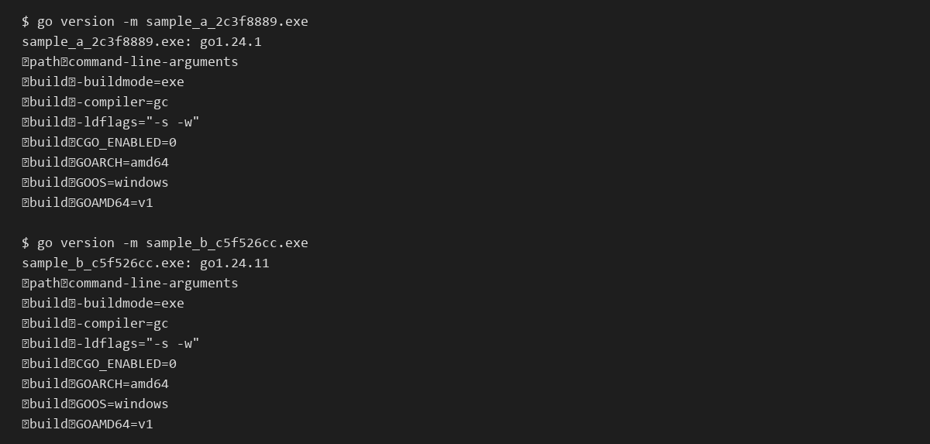
Figure 1 — Go build-info comparison (go1.24.1 vs go1.24.11)
5. Victim Negotiation Identifiers
Embedded alphanumeric strings in both samples have previously been described as virtual-machine or sandbox markers. Offset-level review of the embedded ransom-note text shows they are instead per-build negotiation identifiers presented to the victim as an authentication token for the contact portal.
| Sample | Identifier | Offset | Context |
| A | NSPIREVMKR9GEWW | 0x18c20e | “Send this UUID so make sure, it is you” |
| B | NSPIREUMK44ACC9 | 0x18d557 / 0x18dc8d | “First say UUID” |
Table 5 — Victim negotiation UUID identifiers

Figure 2 — UUID strings sit inside the ransom-note text, not in an anti-VM routine.
6. Cryptographic Architecture
6.1 Package and Primitive Inventory
| Component | Observed |
| crypto/rsa | Present (x32 references) |
| crypto/aes / crypto/cipher | Present (x12 / x12 references) |
| crypto/x509 | Present (x19 references) |
| ed25519 | Present (x24 references) — used for signature generation, not bulk encryption |
| sha256 | Present (x40 references) |
| crypto/internal/fips140 | Present (x736 references) — standard Go 1.24 toolchain artifact, not custom hardening |
| ChaCha20 | Absent |
| HKDF | Absent |
Table 6 — Cryptographic package and primitive inventory
6.2 Recovered Function Surface
The following function names were recovered directly from pclntab, which remains populated even though the COFF symbol table was stripped at compile time.
| main.EncryptRSA main.GenerateRandomKey main.GenerateRandomNonce main.generateSalt main.EncryptFile main.EncryptDir main.changeFileName main.MakeReadMeFile main.writeToTail main.bytesToPublicKey main.generateSignValue (ed25519) main.checkPossibility main.getEncryptionType main.encryptMethod main.startEncrypting main.AddedSpecifier |

Figure 3 — Function names from samples
6.3 Embedded Public Keys
| Sample | SPKI SHA-256 Fingerprint |
| A | ca343308d30c686d77acb46384b44987b88d167d10d3f43edd2e6e0d8e02b5a6 |
| B | d0332ea23d19e67d4a28f8d3ec02e8b37cf3a98d4738d7a75fc33d67d930008a |
Table 7 — Per-sample RSA-4096 SPKI fingerprints
Both recovered keys are RSA-4096 with public exponent 65537, encoded as a 550-byte DER SubjectPublicKeyInfo structure, and are distinct between builds—indicating per-build keypair generation rather than a single key reused across victims. Sample B’s ransom note self-describes the scheme as AES-256 / RSA-4096, consistent with the static recovery.

Figure 4 — Distinct RSA-4096 SPKI fingerprints for Sample A and Sample B.
| Correction to Public Reporting Static evidence from these two builds does not support the RSA-2048 / ChaCha20 / HKDF description that has circulated in some open-source coverage of this family. These builds use AES for bulk file encryption with the resulting key and nonce wrapped under a per-build RSA-4096 public key. Other builds of this family may differ; this finding is scoped to the two samples analyzed. |
7. Binary and Encryption Workflow
The PE layout and the high-level encryption / note-drop workflows below are reconstructed from the recovered function surface and static string inventory.
7.1 PE Section Layout
Both samples share the same eight-section layout. Entropy and import characteristics are consistent with an unpacked, statically linked Go binary.
| Section | Contents |
| .text | Compiled Go code (entropy ~6.25); no packing indicators |
| .rdata | Go pclntab, string constants, ransom-note text, embedded RSA public key |
| .data / .pdata / .xdata | Standard Go runtime data structures |
| .idata | Import table — kernel32.dll only (46 functions) |
| .reloc / .symtab | Relocation table; residual Go symbol-table section header |
Table 8 — Shared PE section layout
7.2 File Encryption Workflow
| Directory walk (EncryptDir) | → | Per-file key/nonce (GenerateRandomKey) | → | AES encrypt (EncryptFile) | → | RSA-wrap key (EncryptRSA) | → | Append + rename (writeToTail) |
Table 9 — Reconstructed file-encryption workflow

Figure 5 — Per-file tail sizes (696 B / 684 B) match RSA-4096, not RSA-2048.
7.3 Ransom Note Deployment Workflow
| Directory walk (EncryptDir) | → | Drop ransom note (MakeReadMeFile) | → | Embed UUID + contact info | → | Root-level drop (_nightspire_readme.txt) |
Table 10 — Reconstructed ransom-note deployment workflow
8. Extortion Model Evolution
Side-by-side comparison of ransom-note content and deployment behavior shows a clear progression from a targeted, informal extortion approach to a standardized double-extortion model.
| Characteristic | Sample A (v1) | Sample B (v2) |
| Note greeting | “Hi, MasterBaker Guys!” (target-specific) | “NightSpire Encryption Notice” (standardized) |
| Note deployment | Dropped across 28 distinct directories | Single drop at drive root: C:\_nightspire_readme.txt |
| Encryption claim in note | Not specified | “AES-256 / RSA-4096” |
| Payment structure | Unstructured, no deadline | Staged demands with a leak-schedule timeline |
| Leak schedule | None | Day 10 — blog notice; Day 14 — full data dump |
| Data exfiltration menu | Not present | Structured categories: PII, credentials, financial data, source code |
| Upsell | None | Additional $50,000 “security audit” offer |
Table 11 — Extortion-model evolution between Sample A and Sample B

Figure 6 — Sample A ransom note (target-specific greeting; UUID NSPIREVMKR9GEWW).

Figure 7 — Sample B ransom note (AES-256/RSA-4096; Day 10 / Day 14 leak clock).
8.1 Anti-Analysis Timing Behaviour
Both samples implement a thread suspend/resume loop consistent with timing-based sandbox evasion. The intensity of this behavior increases substantially between builds. This was detected by PRIM_THREAD_SUSPEND_RESUME_LOOP, Vehere’s exclusive Sandbox signature.
| Sample | Suspend/Resume Pairs | Threads Involved |
| A | 31 | 4 |
| B | 161 | 5 |
Table 12 — Thread suspend/resume timing behavior
9. Dynamic Analysis
Both samples were detonated to validate the static findings against runtime behavior. Detonation was performed without network egress; the observations below reflect host-level behavior only.
9.1 Sample A — Detonation Summary
Live detonation metadata for Sample A is summarized below.
9.2 Sample A — Vehere Detections
Behavioural signatures reported for Sample A:

Figure 8 — Sample A sandbox report with execution kill chain (final score 100.0 / 100, malicious verdict)

Figure 9 — Sample A behavioral signatures (malicious)

Figure 10 — Sample A YARA intelligence (5 rules matched, including Ransomware_Win_NightSpire_ImmoRan_Core)

Figure 11 — Sample A MITRE ATT&CK tactics and techniques (10 techniques observed)
Process hollowing (T1055.012) was reported by the sandbox engine for Sample A and was not evident from the static encryptor surface reconstructed in Sections 6–7. This technique should be treated as engine-detected pending further static confirmation of an injection path.
9.3 Sample B — Detonation Summary
The runtime alias enc.exe recovered during detonation matches third-party reporting that attributed an enc.exe artifact to this family, confirming it as an observed filename for this sample rather than merely an unconfirmed sibling.
9.4 Sample B — YARA Intelligence
Sample B matched the same YARA intelligence rule set as Sample A, including Ransomware_Win_NightSpire_ImmoRan_Core (Figure 10).
9.5 Cross-Sample Behavioural Comparison
Event-log clearing and broader directory traversal (including the public profile) appear in the Sample A run but not in Sample B. That difference is consistent with the static finding that v1 scattered its ransom note across many directories, while v2 drops a single note at the drive root.
9.6 Dynamically Confirmed ATT&CK Techniques
| Vehere Sandbox Signature | MITRE ATT&CK | Type |
| PRIM_PROCESS_HOLLOWING_SEQUENCE | T1055.012 | Primitive |
| PRIM_MASS_USER_FILE_WRITE | T1486 | Primitive |
| PRIM_THREAD_SUSPEND_RESUME_LOOP | T1497 | Primitive |
| PRIM_UNKNOWN_SECTION_PACKER | T1027.002 | Primitive |
| PRIM_HWID_VOLUME_PROFILING | T1082, T1497 | Primitive |
| PRIM_MASS_FILE_ACCESS_WRITE_DELETE | T1486, T1485 | Primitive |
| PRIM_MASS_FILE_DELETE | T1485, T1486 | Primitive |
| PRIM_MASS_RANSOM_NOTE_DROP | T1486 | Primitive |
| PRIM_RANSOM_MESSAGE_WRITE | T1486, T1657 | Primitive |
| PRIM_EVENT_LOG_CLEAR | T1070.001 | Primitive |
| PRIM_PUBLIC_PROFILE_ACCESS | T1083 | Primitive |
| PRIM_PROCMEM_YARA_MATCH | T1055 | Primitive |
| AGGR_RANSOMWARE_BEHAVIORAL_CLUSTER | T1486, T1485, T1657, T1055 | Aggregator |
| CORR_RANSOMWARE_IMPACT_CHAIN | T1055.012, T1497, T1027.002, T1082, T1083, T1055 | Correlation |
Table 13 — Sample A behavioral signature rules and ATT&CK mapping
| Technique | Name | Evidence Basis |
| T1486 | Data Encrypted for Impact | .nspire renames, bulk ciphertext writes, RSA/AES surface, ransom-note drop |
| T1497 | Virtualization/Sandbox Evasion | Thread suspend/resume timing loop and associated kernel32 imports |
| T1657 | Financial Theft | Ransom note plus Tor-based payment and contact infrastructure |
| T1055.012 | Process Hollowing | Sandbox-reported process-hollowing API sequence (Sample A) |
| T1027.002 | Software Packing | Non-standard / unusual PE section indicators reported at launch |
| T1070.001 | Clear Windows Event Logs | Event-log clear behavior observed in the Sample A detonation |
| T1485 | Data Destruction | Mass file delete / overwrite patterns in behavioral signatures |
| T1082 | System Information Discovery | HWID / volume serial profiling during execution |
| T1083 | File and Directory Discovery | Public-profile and directory traversal during encryption workflow |
Table 14 — Core ATT&CK techniques with evidence basis
10. Indicators of Compromise (IOCs)
The indicators below are scoped to the two builds analyzed in this report unless otherwise noted.
10.1 File Hashes
| SHA-256 (Sample A): 2c3f8889c9f5d765632ad91b4cc2a852c54845e143dbd2b68359b6f9cdfd8f99 SHA-256 (Sample B): c5f526cc62688cf34c49d098dab81e24e4294f832ada57433ef505d5ac6da8f3 |
10.2 Ransom Artifacts
- *_nightspire_readme.txt
- *.nspire (encrypted-file extension)
- C:\[NSPIRE_MSG].txt (related family variant, per third-party reporting)
- enc.exe (executable name observed as a Sample B runtime alias; also reported for a related family variant)
10.3 Victim Negotiation UUIDs
- NSPIREVMKR9GEWW
- NSPIREUMK44ACC9
10.4 Build-Path Pivots
- ImmoRan
- Immotal Ransomware
- Dev_Pack\Encrypter
- Dev_Tools\Encrypter
10.5 RSA-4096 SPKI Fingerprints (SHA-256)
| Sample A: ca343308d30c686d77acb46384b44987b88d167d10d3f43edd2e6e0d8e02b5a6 Sample B: d0332ea23d19e67d4a28f8d3ec02e8b37cf3a98d4738d7a75fc33d67d930008a |
10.6 Network / Contact Infrastructure
| Type | Value |
| Onion (leak site) | a2lyiiaq4n74tlgz4fk3ft4akolapfrzk772dk24iq32cznjsmzpanqd[.]onion |
| Onion (contact) | nspireyzmvapgiwgtuoznlafqvlyz7ey6himtgn5bdvdcowfyto3yryd[.]onion |
| Onion (active leak site) | nspirebcv4sy3yydtaercuut34hwc4fsxqqv4b4ye4xmo6qp3vxhulqd[.]onion |
| Onion (sibling variant) | nspire7lugml7ybqyjaaxtsgrs4qn3fcon3lrjbih6wamttvdm5ke4qd[.]onion |
| Onion (additional) | nspiremkiq44[…][.]onion |
| Nightspireteam[.]receiver@onionmail[.]org | |
| night[.]spire[.]team@gmail[.]com | |
| night[.]spire[.]team@onionmail[.]org | |
| night[.]spire[.]team@proton[.]me | |
| nightspire[.]team2026@onionmail[.]org | |
| qTox (v1, previously published) | 3B61CFD6E12D789A439816E1DE08CFDA58D76EB0B26585AA34CDA617C41D5943CDD15DB0B7E6 |
| qTox (v2, newly recovered) | 8D663FD10BF662930F4C076CBF95FACFCC4ABD8F1A5E328DE75D0B0237A74E1AE1E0C5C37E7F |
Table 15 — Network and contact infrastructure indicators
10.7 Vendor Signature Names
- SonicWall: GAV: NightSpire.RSM
- AhnLab: .C5769860 / .C5775165
Assessment
NightSpire’s builder toolchain reflects a small, actively maintained development effort rather than a large engineering organization: unversioned go build invocations, a persistent internal project name across builds, and increasing anti-analysis sophistication between the two samples. Distinctive pivots from this work include the ImmoRan / Immotal build paths, both negotiation UUID markers, and per-build RSA-4096/AES encryption—correcting prior RSA-2048/ChaCha20/HKDF descriptions applied to this family in open-source reporting.
11. Recommendations
- Hunt on the ImmoRan / Immotal build-path fragments and the two negotiation UUID strings. At present they provide a low false-positive detection surface across endpoint and file-scanning pipelines.
- Prioritise patching or compensating controls for CVE-2024-55591 on internet-facing FortiOS / FortiProxy appliances and monitor for anomalous RDP authentication attempts given this group’s documented initial-access preferences.
- Treat the documented onion domains as a related infrastructure set for blocking purposes, recognizing that individual domains are expected to rotate.
Appendix A: Related Family Variant
Third-party reporting documents a related sample using the executable name enc.exe and the ransom-note filename C:\[NSPIRE_MSG].txt, along with an additional onion domain (nspire7lugml7ybqyjaaxtsgrs4qn3fcon3lrjbih6wamttvdm5ke4qd[.]onion). Overlapping ATT&CK techniques remain T1486, T1497, and T1657 after exclusion of environment-induced detections. This variant was not independently obtained or statically analyzed for this report.
12. References
The following external sources support attribution, infrastructure, sample corroboration, and vulnerability context cited in this report. Vehere Sandbox detonation results and static analysis of Samples A and B are original to this work.
[1] S-RM Intelligence. Ransomware in focus: Meet NightSpire. https://www.s-rminform.com/latest-thinking/ransomware-in-focus-meet-nightspire – Threat-actor attribution, Rbfs lineage, and operator handles (xdragon128, cuteliyuan).
[2] Halcyon. NightSpire threat group profile. https://www.halcyon.ai/threat-group/nightspire – Group profile, initial-access patterns, and operational tempo assessment.
[3] Huntress. Decoding NightSpire: Ransomware IOCs Aren’t Set in Stone. https://www.huntress.com/blog/nightspire-ransomware – Related enc.exe encryptor and [nspire_msg].txt ransom-note variant observations.
[4] AttackIQ. Emulating the Persuasive NightSpire Ransomware. https://www.attackiq.com/2026/04/14/nightspire-ransomware/ – Independent emulation of Sample B (SHA-256 c5f526cc62688cf34c49d098dab81e24e4294f832ada57433ef505d5ac6da8f3) and embedded negotiation UUID.
[5] MalwareBazaar. NightSpire malware signature listing. https://bazaar.abuse.ch/browse/signature/NightSpire/ – Public indexing of NightSpire-tagged samples, including both analyzed SHA-256 hashes.
[6] Fortinet PSIRT. FG-IR-24-535: FortiOS and FortiProxy authentication bypass (CVE-2024-55591). https://fortiguard.fortinet.com/psirt/FG-IR-24-535 – Vendor advisory for the FortiOS / FortiProxy authentication bypass cited in Recommendations.
[7] CISA. Known Exploited Vulnerabilities Catalog: CVE-2024-55591. https://www.cisa.gov/known-exploited-vulnerabilities-catalog?field_cve=CVE-2024-55591 – U.S. government tracking of in-the-wild exploitation for CVE-2024-55591.
[8] Broadcom Symantec. NightSpire Ransomware protection bulletin. https://www.broadcom.com/support/security-center/protection-bulletin/nightspire-ransomware – Vendor detection naming context (including third-party AV labels for the family).
[9] Ransomware.live. NightSpire group tracking. https://www.ransomware.live/group/nightspire – Public victim-count and leak-site tracking referenced in the threat-actor profile table.