
Every Cyberattack Has One Thing in Common
Ransomware, insider threats, phishing, supply chain attacks, and Advanced Persistent Threats (APTs) may have different objectives, but they all share one characteristic , they generate network activity.
Attackers don’t simply compromise a system and launch an attack immediately. They move laterally, communicate with command-and-control servers, scan internal assets, escalate privileges, and transfer data before achieving their objective. Every one of these actions leaves evidence on the network.
The challenge isn’t whether the evidence exists. The challenge is whether security teams can detect it before it’s too late.
This is exactly where Network Detection and Response (NDR) changes the game.
Why Traditional Security Isn’t Enough
Most organizations already have:
- Firewalls
- EDR
- SIEM
- Email Security
- Identity Management
These technologies are essential. But they only see part of the picture.
Firewalls monitor the perimeter. EDR monitors managed endpoints. SIEM correlates logs after the fact. NDR watches what attackers actually do inside the network, in real time.
Instead of waiting for a malware signature to match, NDR identifies suspicious behavior , lateral movement, command-and-control communication, unusual DNS requests, data exfiltration, and insider activity , regardless of whether the tool involved has ever been seen before.
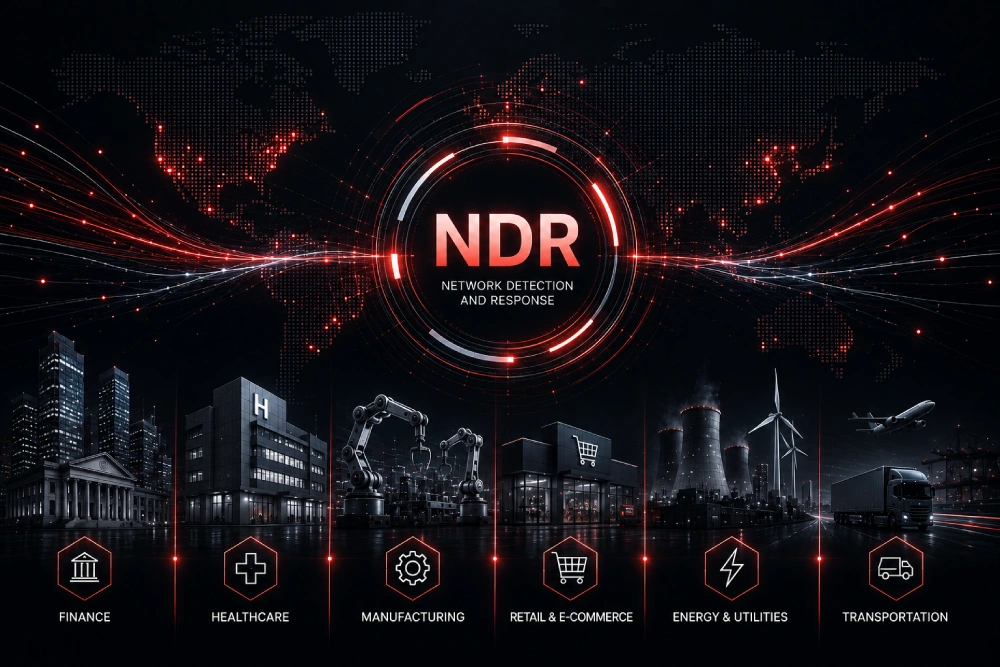
How Different Industries Rely on NDR
The risks look different in every sector. The underlying gap NDR closes is the same: nobody’s watching the inside of the network closely enough. Here’s what that looks like industry by industry.
Banking and Financial Services
The Challenge
Banks process millions of transactions every day. A single compromised administrator account or successful phishing attempt can let an attacker move silently through core banking infrastructure for weeks before anyone notices.
Where NDR Helps
Rather than relying only on login alerts, NDR flags:
- Lateral movement between banking servers
- Abnormal SWIFT communication patterns
- Suspicious encrypted sessions between systems that don’t normally talk
- Early-stage data exfiltration attempts
Did You Know? Multi-million-dollar SWIFT fraud incidents, like the 2016 Bangladesh Bank heist, succeeded largely because attackers operated undetected inside the network for an extended period , exactly the kind of internal movement NDR is built to catch.
Government and Public Sector
The Challenge
Government networks face ransomware, espionage, and nation-state APTs. Unlike opportunistic cybercriminals, these attackers often prioritize staying hidden for months over acting quickly.
Where NDR Helps
NDR surfaces:
- Internal reconnaissance and scanning
- East-west movement between agency systems
- Command-and-control beaconing
- Long-term footholds that outlast a single incident response cycle
Industry Insight: Nation-state intrusions are frequently discovered not through a single alarming event, but through subtle behavioral anomalies accumulating over time , the pattern behavioral detection is designed to catch, where signature-based tools stay silent.
Healthcare
The Challenge
Hospitals depend on thousands of connected devices , MRI scanners, infusion pumps, patient monitors , many of which can’t run traditional endpoint security software at all.
Where NDR Helps
NDR continuously monitors:
- Medical IoT device traffic
- Electronic Health Record (EHR) system access
- Laboratory and diagnostic equipment communication
- Clinical network behavior more broadly
Did You Know? Ransomware attacks on hospitals have repeatedly forced emergency departments to divert ambulances and delay procedures. When downtime directly affects patient care, early detection isn’t just a security metric , it’s a clinical one.
Manufacturing
The Challenge
Manufacturers run both IT and Operational Technology (OT) environments side by side. A ransomware attack here doesn’t just encrypt files , it can physically halt production lines.
Where NDR Helps
NDR identifies:
- Unauthorized communication with PLCs
- Misuse of engineering workstations
- Supply chain-originated attacks entering through trusted vendors
- Abnormal industrial protocol behavior
Industry Insight: In manufacturing, a cybersecurity incident rarely stays a cybersecurity incident , it becomes an operational one, with production delays and financial losses following close behind. The 2017 NotPetya attack, which crippled shipping giant Maersk’s operations for days, is a widely cited example of a network intrusion turning into a physical-world shutdown.
Retail and E-Commerce
The Challenge
Retailers manage payment systems, customer databases, and online platforms that are under near-constant attack, often through third-party vendor access.
Where NDR Helps
NDR detects:
- Point-of-Sale malware communicating outbound
- Credential abuse across store and e-commerce systems
- Payment data exfiltration attempts
- Unauthorized remote access into POS networks
Did You Know? Large-scale retail breaches have repeatedly traced back to attackers who gained a foothold through a third-party vendor connection and then moved laterally into payment systems undetected , the exact blind spot network-level monitoring is designed to close.
Telecommunications
The Challenge
Telecom operators manage massive infrastructures where millions of users generate traffic every second, making anomalies easy to lose in the noise.
Where NDR Helps
NDR provides visibility into:
- Subscriber fraud patterns
- Core network anomalies
- Internal attacker movement across carrier infrastructure
- Suspicious signaling activity between network elements
Industry Insight: Because telecom networks carry such enormous baseline traffic volumes, behavioral baselining matters more here than almost anywhere else , a static list of “known bad” indicators simply can’t keep pace with the scale.
Energy and Utilities
The Challenge
Critical infrastructure has become a strategic target for both criminal and state-sponsored attackers. Compromising operational networks can disrupt essential public services, not just data.
Where NDR Helps
NDR monitors:
- SCADA system communications
- Remote maintenance session activity
- Industrial protocol anomalies
- Unauthorized access attempts into OT environments
Did You Know? The 2021 Colonial Pipeline ransomware attack, which disrupted fuel supply across the US East Coast, originated not in the OT environment itself but in IT systems , a reminder that visibility has to span both sides of the network, not just the industrial floor.
Education and Research
The Challenge
Universities support thousands of unmanaged personal devices connecting to open networks every day, often with minimal centralized control.
Where NDR Helps
NDR automatically discovers:
- Rogue and unmanaged devices joining the network
- Malware command-and-control communication
- Crypto-mining activity running quietly on compromised machines
- Attempted exfiltration of sensitive research data
Did You Know? Universities are frequent targets for research theft precisely because they must balance open access with security , making network-level visibility one of the few controls that works without restricting the openness the institution depends on.
One Technology, Different Outcomes
Every industry faces different risks, shaped by different systems, regulations, and attacker motivations. But the underlying security objectives converge:
- Detect threats earlier
- Reduce attacker dwell time
- Investigate incidents faster
- Protect unmanaged and unmanageable devices
- Strengthen compliance posture
- Improve SOC efficiency
That’s exactly where NDR delivers value , not as a replacement for firewalls, EDR, or SIEM, but as the layer that watches what those tools can’t see.
Final Thoughts
Cybersecurity is no longer only about building stronger perimeters. It’s about understanding what’s happening inside your network before attackers achieve their objective.
Whether you’re protecting financial transactions, patient records, manufacturing plants, government infrastructure, or critical utilities, the network tells the complete story of an attack. Network Detection and Response gives security teams the visibility to read that story in real time , helping them detect threats earlier, investigate with confidence, and respond before an incident becomes a business crisis.
Want to see how NDR would work inside your own environment? Reach out for a walkthrough of how behavioral detection applies to your specific infrastructure.