Introduction
With 26% of occurrences worldwide in 2024, the industrial sector continues to be the most targeted industry for cyberattacks on manufacturing for the fourth year in a row. This persistent targeting reflects manufacturing’s critical role in global supply chains, its dependence on legacy systems, and the high value of its intellectual property, according to the recently published IBM X-Force Threat Intelligence Index 2025.
The industrial industry continues to be a target for both nation-state actors and hackers, despite worldwide advancements in cybersecurity. The industry was hit hard by ransomware in manufacturing, extortion, and data theft efforts in 2024, endangering not only data security but also the ability of companies and supply chains around the world to continue operating.
Why Manufacturing Remains a Prime Target
Modern economies are built on manufacturing that produces everything from electronics and auto parts to medical equipment and aerospace parts. It’s crucial significance also makes it a desirable target for cybercriminals looking for:
- Designs, formulas, patents, and procedures are all considered forms of intellectual property (IP).
- Operational Disruption: Supply chains and revenue can be severely damaged by stopping production lines.
- Extortion Opportunities: Because of the significant expenses of downtime, ransomware operations in manufacturers frequently result in large rewards.
Manufacturing settings frequently rely on outdated technologies that are challenging to update or repair without posing a serious operational risk, according to IBM’s analysis. Numerous attack avenues are made available to cybercriminals by this technological debt in conjunction with an extensive network of partners and providers.
Ransomware Reigns Supreme
The manufacturing threat landscape is still dominated by ransomware. The industry saw the most ransomware cases in 2024 out of all industries combined.
For the third consecutive year, the number of ransomware occurrences worldwide decreased, but the industrial sector defied the trend by reporting more attacks than any other industry. Cyberattacks on manufacturing involves threat actors threatening to disclose stolen materials unless large ransoms were paid, using ransomware not only to encrypt files but also to steal confidential information.
The IBM analysis highlights the growing sophistication of extortion tactics. To coerce victims into paying, attackers commonly use double extortion tactics, which involve encrypting data while also obtaining confidential information. Attackers sometimes even choose to use extortion without encryption, depending only on the possibility of data leaks to the public.
Top Impacts: Extortion and Data Theft
IBM’s analysis reveals that the two most significant impacts on manufacturing organizations in 2024 were:
- Extortion (29%): To stop the public release of stolen data or to restore functional systems, threat actors sought ransom payments.
- Data Theft (24%) – By undermining competitive advantage, harming brand reputation, and drawing regulatory attention, stolen intellectual property and confidential data can cause manufacturers to collapse.
Additionally, credential harvesting (18%) emerged as a notable threat, as attackers sought to collect login credentials that enable deeper infiltration into enterprise networks.
Methods of Attack
The IBM X-Force report identifies multiple pathways used to infiltrate manufacturing environments. The most common initial access vectors were:
- Public-Facing Application Exploitation (29%) – Attackers targeted internet-accessible web applications and services that were deemed vulnerable.
- Valid Accounts – Domain (21%) — To log in covertly, threat actors are increasingly depending on credentials that have been stolen.
- External Remote Services (21%), such as remote desktop technologies and virtual private networks (VPNs), are used to penetrate manufacturing networks.
These methods reflect a broader trend where attackers prefer stealth over brute force. As IBM states, “Hackers don’t break in; they log in.”
Living Off the Land
The tactic known as “living off the land” is a common motif in cyberattacks on manufacturing companies. Attackers employ genuine tools and administrative utilities that are existing in the victim’s environment rather than delivering blatant malware that could set off alarms.
This greatly increases the difficulty of detection. According to IBM’s analysis, threat actors are using legal IT technologies more frequently in manufacturing networks for data collection, privilege escalation, and lateral movement.
Geographic Hotspots
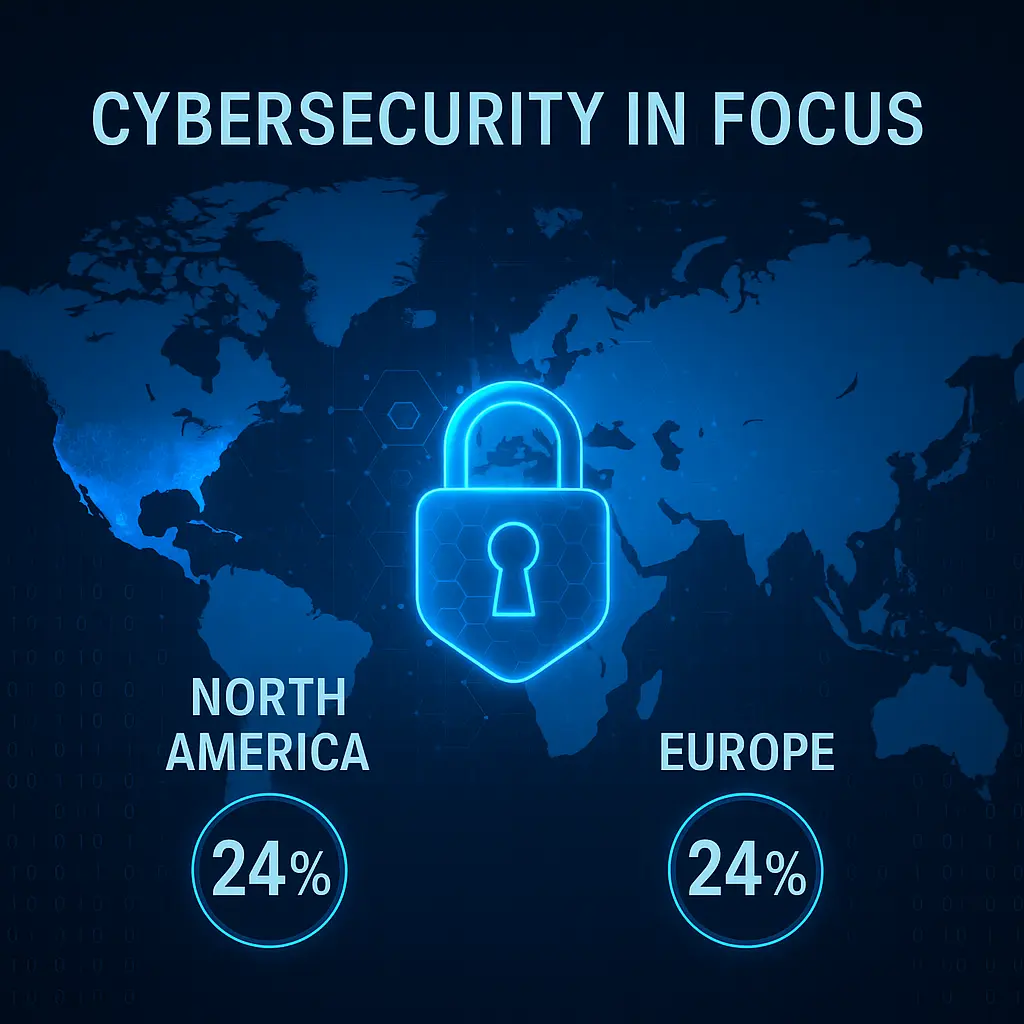
Although industry is a global target, 56% of manufacturing-related cyber events in 2024 occurred in the Asia-Pacific area, making it the epicenter of these attacks. Given the concentration of manufacturing hubs in APAC and its crucial role in global supply chains, this is not surprising.
Due to its industrial backbone, North America had the second-highest percentage of manufacturing events (22%), followed by Europe (16%) and Latin America (7).
The Role of Supply Chain Risks
Manufacturers’ large supply chain networks are one of their biggest weaknesses. Attacks on outside vendors have the potential to swiftly affect main industrial processes.
The fact that manufacturers rely on a vast network of suppliers, contractors, and technology providers is recognized by threat actors. Attackers can gain access to larger manufacturing targets by compromising smaller partners and taking advantage of trust ties. This expands the scope of supply chain cyber risks.
Recommendations for Manufacturers
The IBM report calls for urgent, sector-specific cybersecurity measures. Manufacturers must:
- Adopt the Zero Trust Principles: Always double-check, never trust. Even internal users should have their access attempts closely examined.
- Segment Networks: To prevent any intrusions, separate vital industrial networks from IT systems.
- Patch Vulnerabilities – Give top priority to vulnerabilities that attackers commonly exploit in applications that are visible to the public.
- Strengthen Identity and Access Controls: Put strong multi-factor authentication into place and keep an eye out for odd login trends.
- Create Cyber Crisis Playbooks: Create incident response strategies for situations like ransomware and data theft.
As Mark Hughes, IBM’s Global Managing Partner for Cybersecurity Services, emphasizes in the report:
“Businesses need to shift away from an ad-hoc prevention mindset and focus on proactive measures such as modernizing authentication management, plugging multi-factor authentication holes, and conducting real-time threat hunting.”
How Vehere NDR Helps Mitigate Manufacturing Cyber Risks
Vehere’s Network Detection and Response (NDR) solution is purpose-built to address the evolving threat landscape that manufacturers face today. Here’s how it tackles the most pressing challenges:
1. Deep Visibility Across Legacy and Modern Environments
Vehere NDR continuously monitors all east-west and north-south traffic using advanced packet-level analytics. It provides full visibility across hybrid OT/IT environments, including those running outdated or unpatched systems.
2. Built-In Packet Capture for Forensic Analysis
Vehere offers 100% lossless, built-in full packet capture (FPC), allowing security teams to replay incidents in full detail. This is especially critical for detecting and investigating ransomware, data exfiltration, and credential misuse—all key threats to manufacturing.
3. Real-Time Detection of Living-off-the-Land Tactics
Using behavioral analytics and machine learning, Vehere detects subtle anomalies, such as abnormal use of legitimate tools or privilege escalation patterns, helping catch “living off the land” attacks early before they escalate.
4. Supply Chain Attack Detection
Vehere NDR can monitor third-party access and detect suspicious lateral movement or compromised credentials originating from vendor networks—crucial for identifying backdoor entries from compromised supply chain partners.
5. Accelerated Response and Integration
The solution integrates with SIEM, SOAR, and endpoint protection platforms to automate response workflows. With indexed metadata and alert-to-packet workflows, teams can immediately investigate and respond to threats, reducing dwell time and impact.
6. Geographic and Sector-Specific Threat Intelligence
Vehere’s threat intelligence engine is updated with sector-specific indicators of compromise (IoCs) and region-specific threat patterns, ensuring tailored protection for manufacturing hubs in APAC, North America, and beyond.
A Call to Action
Manufacturing is under siege, as outlined in the IBM X-Force Threat Intelligence Index 2025. The rise in cyberattacks—especially ransomware and data theft—demands an immediate, industry-specific response.
Vehere NDR provides the visibility, detection, and forensic depth that manufacturers need to defend their critical infrastructure. As attackers grow more advanced and stealthier, relying on logs and outdated defences is no longer enough. Packet-level intelligence and behavioral analytics are now essential weapons in the manufacturing sector’s cyber arsenal.
Cybersecurity must become as integral to manufacturing operations as quality assurance and supply chain logistics. The time for passive defence is over. Manufacturers must act now—with proactive, scalable solutions like Vehere NDR—to secure their future.