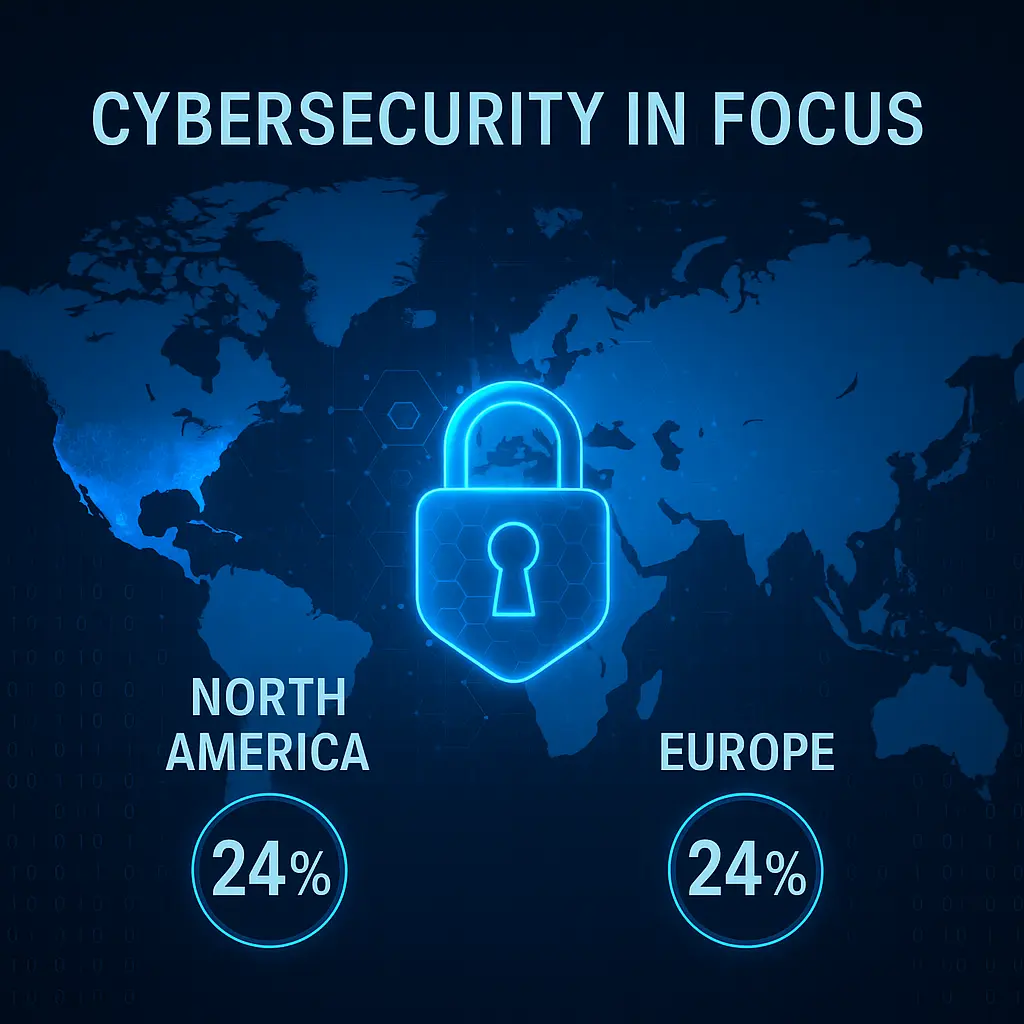
Cybersecurity continues to stand at the forefront of global risk management. In 2024, Cybersecurity in North America and Europe each contributed 24% of all cyberattacks worldwide, tying as the world’s second most targeted regions after Asia-Pacific (34%), according to IBM’s X-Force Threat Intelligence Index 2025.
These findings underscore a sobering truth: even the world’s most advanced economies with mature digital infrastructures and stringent security regulations remain prime hunting grounds for cyber adversaries. Their critical role in global commerce, finance, manufacturing, and infrastructure makes them irresistible to threat actors whose motivations span from financial extortion to espionage.
What is striking in these results is not only the volume of attacks, but the type of attacks seen in each region. Both North America and Europe face growing credential-centric assaults, but the consequences differ. In North America, compromised login data frequently feeds espionage and ransomware operations. In Europe, breaches often escalate into public data leaks, where exposure itself becomes the weapon due to strict GDPR penalties.
North America: Credential Harvesting Takes Center Stage
North America bore a heavy share of global attacks, with the U.S. alone experiencing 86% of incidents in the region. This concentration reflects not only the size of the American economy but also the attractiveness of U.S.-based financial institutions, manufacturers, and service providers. Attackers know that breaching a single U.S. company can yield massive returns.
Perhaps the most telling trend in 2024 was the rise of credential harvesting, which accounted for 40% of primary impacts observed. The adage “hackers don’t break in; they log in” rings especially true here. Instead of launching noisy, brute-force attacks, adversaries simply purchased stolen credentials on the dark web or harvested them through phishing campaigns to quietly access systems.
Top Attack Vectors
- Exploitation of Public-Facing Applications (40%) – By abusing unpatched software vulnerabilities, attackers gained entry through systems designed to be widely accessible.
- Valid Accounts – Cloud (27%) – Stolen login details were used to impersonate legitimate users, bypassing many traditional security defenses.
This credential-first approach allows attackers to move laterally within networks, escalate privileges, and launch follow-on attacks that are harder to detect.
Threat Impacts
- Credential Harvesting (40%) – the leading outcome, linked to ransomware, insider-style breaches, and espionage.
- Data Theft (30%) – including intellectual property and sensitive customer data.
- Espionage, Extortion, and Brand Damage (10% each) – signaling diverse attacker motivations beyond simple theft.
Industry Targets
The industries most affected highlight why North America remains so attractive to adversaries:
- Manufacturing (24%) – critical due to its integration into global supply chains.
- Finance and Insurance (20%) – housing rich stores of personal and transactional data.
- Professional, Business, and Consumer Services (20%) – exposing risks linked to outsourcing and third-party relationships.
Taken together, these trends show how North America is caught between nation-state adversaries leveraging strategic espionage and criminal syndicates chasing financial gain.
Europe: Credential Harvesting and Data Exposure Dominate
In examining Cybersecurity in North America and Europe, Europe, too, accounted for 24% of global cyberattacks in 2024, with the UK (25%), Germany (18%), and Austria (14%) as the prime targets. Unlike North America, where espionage plays a stronger role, Europe saw a larger share of attacks turn into data exposure incidents — a tactic designed to create reputational damage alongside financial loss.
Europe’s heavy reliance on cross-border commerce, coupled with its strong regulatory environment, shapes the region’s cyber risk landscape. Data leaks in Europe carry greater consequences because of the stringent enforcement of GDPR, where even accidental breaches can trigger multimillion-euro fines. Attackers exploit this pressure, weaponizing the reputational and financial fears of European companies by threatening public disclosure.
Top Attack Vectors
- Exploitation of Public-Facing Applications (36%) – the leading weak point in Europe’s digital defense.
- Server Access (15%) – enabling direct control of systems often as a precursor to extortion schemes.
- Credential Acquisition Tools (12%) – signaling the centrality of identity theft campaigns.
Threat Impacts
- Credential Harvesting (46%) – the single most dominant threat, putting Europe at the heart of identity-driven cybercrime.
- Data Leaks (31%) – far more prominent here than in North America, owing to the reputational and legal risks.
- Data Theft (15%) – focusing mainly on intellectual property and personal customer data.
Industry Targets
The industries most impacted were:
- Professional, Business, and Consumer Services (38%) – consulting, IT, and legal services, which act as gateways into client ecosystems.
- Finance and Insurance (18%) – aligned with global cybercrime patterns.
- Manufacturing (18%) – growing more vulnerable as connected technologies expand.
European statistics reinforce the trend of ecosystem infiltration, where adversaries exploit third-party providers and supply networks to reach primary targets indirectly.
Rising Professionalization of Cybercrime
An emerging theme across both regions is the professionalization of cybercrime. According to IBM, attackers are increasingly operating like legitimate businesses, offering “Cybercrime-as-a-Service” packages. These services enable even low-skilled actors to launch sophisticated campaigns using ready-made tools, stolen credentials, or ransomware kits.
This evolution lowers the barrier to entry for cybercrime and exponentially increases the number of actors capable of exploiting organizations in North America and Europe. It is no longer just highly trained hacker collectives at work; today, almost anyone with the funds to subscribe to a dark web service can mount a damaging attack.
What Organizations Can Do
The IBM report emphasizes that organizations in North America and Europe cannot rely on traditional perimeter-based security alone. Instead, they must shift toward adaptive, intelligence-driven approaches. Key recommendations include:
- Adopt Zero Trust Architecture – Assume no user or device can be trusted without verification. Each access request should be continuously authenticated and authorized.
- Harden Identity Management – Deploy MFA, reduce reliance on passwords, and monitor for credential reuse or circulation on the dark web.
- Prioritize Rapid Patching – Vulnerabilities in public-facing applications remain the number one entry point. Swift patch cycles reduce exposure windows.
- Prepare Cyber Crisis Playbooks – Establish clear steps for handling ransomware, extortion, or large-scale data leaks to minimize response times.
- Invest in Threat Intelligence – Proactive monitoring of hacker forums and underground markets helps organizations anticipate active threats before they strike.
- Strengthen Supply Chain Security – Demand higher security standards from third-party vendors, since attackers often exploit weaker links to reach larger firms.
In practice, these measures demand not just tools but also cultural change. Employees must be trained to recognize phishing attempts, security teams must integrate intelligence into daily monitoring, and boards must prioritize resilience as a business imperative.
Vehere’s Perspective: Building Situational Awareness and Cyber Resilience
Vehere, a company that specializes in Network Detection and Response stresses that prevention must go hand-in-hand with continuous detection and response. In today’s ecosystem, where credential harvesting and insider threats dominate, organizations cannot assume that even the strongest defenses will keep every attacker out. Instead, they should:
- Focus on Cyber Situational Awareness – Organizations must be able to “see” their digital environment in real time, including encrypted traffic, east-west movements in networks, and subtle anomalies in user behavior. This extends detection beyond endpoints into the broader infrastructure.
- Integrate Signals Intelligence with Security Operations – By ingesting enriched threat intelligence and communication patterns, defenders gain early-warning indicators of compromise that traditional logs or alerts might miss.
- Automate Threat Hunting and Response – Vehere advises embedding automation into detection and response workflows. This shortens the “dwell time” of attackers inside networks and prevents stolen credentials from being leveraged undetected for weeks or months.
- Adopt Proactive Monitoring of Cloud Environments – With attackers exploiting valid cloud accounts, Vehere stresses the importance of cloud-native monitoring, including visibility into east-west traffic flows and identity-driven anomalies.
- Enhance Insider Threat Detection – Many breaches in both North America and Europe are fueled by compromised insiders or stolen logins. Vehere highlights the importance of behavior analytics and anomaly detection to flag unusual data access or movement.
By combining defense-in-depth strategies (as recommended by IBM) with high-resolution network visibility and situational awareness (advocated by Vehere), organizations can close the blind spots that attackers increasingly exploit. This blended approach ensures that even if adversaries “log in” with stolen credentials, they can still be detected, contained, and disrupted before damage escalates.
Final Thoughts
The findings from IBM’s X-Force Threat Intelligence Index 2025 confirm that Cybersecurity in North America and Europe remain central battlegrounds in the global cyberwar. Both regions face relentless waves of identity-driven attacks, though their outcomes differ: North America grapples with espionage and credential-enabled intrusions, while Europe struggles with the reputational and regulatory fallout of public data leaks.
What unites these challenges is the attacker’s shift toward identity exploitation, ecosystem infiltration, and professionalized cybercrime services. These methods highlight that cybercriminals no longer rely solely on brute force but instead exploit the weakest and most human-driven component of digital systems: trust.
For leaders in government, business, and industry, the takeaway is clear: resilience comes not from thicker walls, but from smarter layers of defense, faster detection, and intelligence-led preparation. The cyber battlefield is no longer about if an attack will happen, but how ready an organization is when it does. Those that adapt to this reality, embracing Zero Trust, securing identities, and preparing to act decisively, will stand the best chance of surviving and thriving in this evolving digital war.