

Network Detection and Response (NDR) has become an important part of modern enterprise cybersecurity. Yet the decision to deploy an NDR solution usually comes from a practical problem.
Security teams already have EDR, firewalls, SIEM platforms, identity controls, email security, cloud security, and other technologies collecting data across the environment. These controls provide valuable visibility, but they cannot answer every question about what is happening across the network.
NDR gives security teams that visibility into network activity and provides packet-level evidence through full packet capture (PCAP) for investigating attacks.
For many organizations, the question is straightforward; what can we learn from the network that we cannot learn from our other security controls?
Here are the ten problems CISOs are trying to solve with NDR.
1. “I can’t see everything on my network.”
Enterprise networks contain far more than managed laptops and servers. Many of the assets on them cannot run an endpoint security agent, including:
- Unmanaged devices
- IoT devices
- Network infrastructure
- Cloud-connected workloads
- OT systems
- Legacy systems
- Third-party devices
- BYOD endpoints
- Printers and other connected devices
Even where an agent is available, it does not provide visibility into every communication taking place around that device. That leaves a visibility gap.
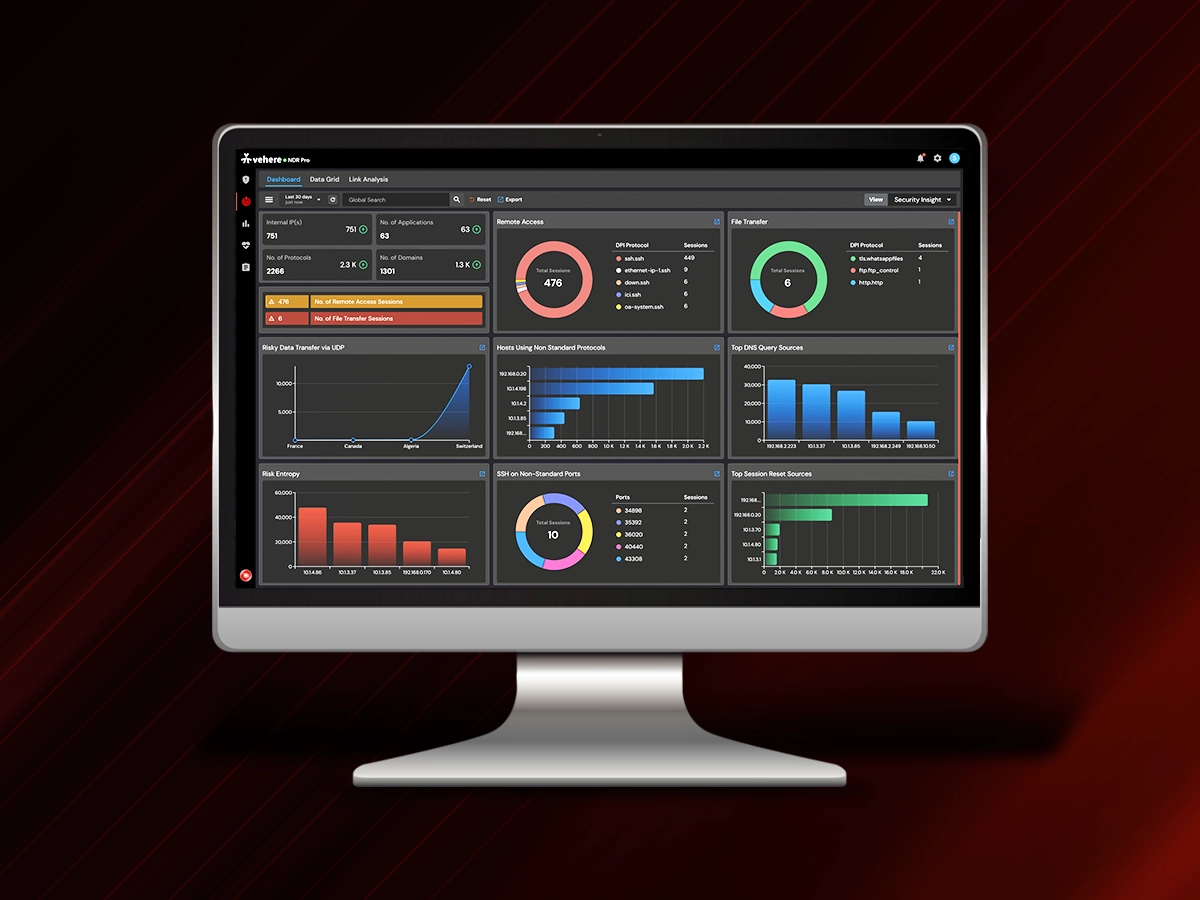
NDR approaches the problem from the network side. It can observe communications between systems and provide information about connections involving assets that may have little or no endpoint telemetry. Vehere NDR works from the traffic itself, so an asset does not need an agent to appear in the picture.
That becomes particularly relevant in large environments where maintaining complete endpoint coverage is difficult.
So, for a CISO, the concern is straightforward; what network activity is taking place outside the visibility of endpoint security?
2. “What if an attacker gets past my endpoint security?”
EDR protects endpoints, but an attack does not end when an endpoint is compromised. Once inside the environment, an attacker may:
- Establish persistence
- Communicate with command-and-control infrastructure
- Discover other systems
- Steal credentials
- Move laterally
- Access sensitive applications
- Exfiltrate data
Much of this activity also leaves evidence in network traffic, regardless of what is visible on the endpoint.
NDR gives security teams another source of evidence by examining those communications and looking for behavior that warrants investigation. This can be useful when an endpoint agent is unavailable, has been bypassed, or simply does not provide enough information to understand what happened after the compromise.
This is why NDR and EDR are often used together. They observe different parts of the same incident.
3. “How is the attacker moving through my environment?”
Finding the initially compromised system does not necessarily tell investigators how far an attack has progressed.
Once inside an environment, an attacker may communicate with additional hosts, use remote services, access internal applications, or interact with systems that were not involved in the original compromise. The significance of those connections often becomes apparent only when they are viewed in relation to other network activity.
NDR helps analysts investigate those relationships.
Suppose a workstation begins communicating with an internal server it has never previously contacted. That connection alone may not establish malicious activity. If it occurs alongside other unusual communications, authentication events, or changes in traffic behavior, however, the wider context becomes useful during an investigation.
This kind of lateral movement detection helps security teams determine whether an incident is confined to one system or involves a broader set of assets.
4. “What if I don’t know what I’m looking for?”
Security teams cannot rely entirely on known indicators of compromise. New infrastructure, previously unseen techniques, compromised legitimate accounts, and unusual internal activity may not match an existing signature or rule.
Examples include:
- An unusual connection between two internal systems
- A server communicating with an unexpected external destination
- A user or device suddenly behaving differently
- An unusual volume of data leaving the network
- A previously unseen protocol or communication pattern
There may be no known malicious IP address or signature associated with any of them.
Behavioral analysis provides another route to detection. NDR platforms examine patterns in network activity and identify deviations from established behavior. This may involve anomaly detection, behavioral analytics, protocol analysis, or other forms of network traffic analysis. Vehere NDR applies multi-agent AI to this work, so unusual behavior can reach an analyst even when no known indicator exists.
The purpose is to surface activity that deserves attention even when the security team does not begin with a known threat indicator.
5. “Something happened. What actually happened?”
An alert rarely answers every question an analyst needs to resolve. Once suspicious activity has been identified, the investigation has to establish:
- When the activity began
- Which device and which user were involved
- What systems communicated with it, and where the connection originated
- What happened immediately before and after the event
- Whether the attacker moved laterally
- Whether data was transferred outside the organization
Network data can provide part of that missing context.
Depending on the NDR architecture, analysts may have access to network metadata, traffic records, session information, or packet-level evidence. That information can help reconstruct communications around an incident and establish a clearer timeline. This is where full packet capture (PCAP) becomes significant. Vehere NDR records the packets themselves, so analysts can go back to the actual traffic around an alert.
Without it, investigators may have to piece together the event from incomplete logs generated by different systems. That can make it harder to determine what actually occurred.
For incident response teams, an alert is only where the work begins.
6. “I need to know whether this was actually a breach.”
Not every security alert represents a confirmed compromise. Security teams often investigate suspicious activity without knowing whether an actual breach occurred. An alert points to suspicious behavior, but the organization still needs evidence.
Network visibility can help validate:
- Whether the communication actually occurred
- Which systems were involved
- Whether the activity spread
- Whether an external destination was contacted
- Whether sensitive systems were accessed
- Whether data was transferred
This makes NDR relevant beyond initial threat detection. It supports incident validation and scoping, and it helps with suspected data exfiltration, since unusual outbound traffic and transfer patterns show up in network data.
For organizations responding to a potential breach, having evidence of the underlying communication can be far more useful than an alert viewed on its own.
7. “My security tools each see only part of the picture.”
A typical security architecture contains many controls; firewall, EDR, SIEM, IDS, email security, cloud security, identity security, and threat intelligence. Each collects information from a different part of the environment.
The firewall may show that a connection was permitted. EDR may show activity on a particular endpoint. Identity systems may record authentication. The SIEM may correlate events from those sources.
The network itself provides another layer of information.
An attack does not operate according to product boundaries. An endpoint may be compromised, communicate with another internal system, use legitimate credentials, access another system, and eventually connect to an external destination.
NDR adds visibility into the communications connecting those events.
NDR sits alongside the other controls and answers the questions they leave open, giving the SOC another source of evidence when individual tools cannot explain the activity.
8. “Which assets are actually compromised?”
An alert may tell an analyst that something suspicious happened. The harder question is which assets to investigate first.
Network relationships can help analysts work through that problem. Instead of treating an isolated connection as a standalone event, analysts can examine the device, user, destination, protocol, historical behavior, and related communications.
That context can change how an alert is interpreted. It can reveal links that would be difficult to see from a single endpoint alert, and it helps analysts decide where to focus first.
In a busy SOC, the challenge is often less about finding another alert and more about deciding which activity deserves closer attention. Vision AI, the multi-agent AI capability in the Vehere platform, is built to help with that prioritization by cutting alert noise and manual triage.
9. “What can I see when the traffic is encrypted?”
Encryption is now pervasive across enterprise networks. It protects data in transit, and it also means security teams cannot always inspect the contents of a communication.
Even without payload visibility, useful information remains. Network metadata can still show:
- Who communicated with whom
- When the communication occurred
- How frequently it occurred
- Which protocols were used
- Connection patterns and traffic volumes
- Destination characteristics
- Changes from established behavior
NDR can use these observable characteristics to identify behavior that may need further investigation. This is particularly relevant to encrypted traffic analysis, where the aim is to judge whether the surrounding behavior looks unusual, without decrypting every communication.
10. “I need network evidence when an incident happens.”
Logs, alerts, and endpoint telemetry are all useful. During a serious investigation, though, security teams often need evidence of what actually crossed the network. They may need to establish how systems communicated, determine when particular connections occurred, examine the progression of an attack, and revisit the evidence later as the investigation develops.
Depending on the deployment, NDR can retain network evidence ranging from metadata and flows to deeper packet-level data. That information can support network forensics, incident investigation, attack reconstruction, and post-incident analysis.
Vehere NDR retains packet-level evidence for forensics and post-incident work. It runs on-premises, allowing organizations to retain that evidence within their own environment. How far back it reaches depends on how the deployment is sized.
Retention also matters. Evidence that was available during an event but was not retained may be difficult or impossible to reconstruct later.
What Problems Does NDR Solve?
The case for NDR is easier to see when each capability is mapped to the problem behind it.
| CISO Problem | How NDR Can Help |
| Network blind spots | Provides visibility into communications across the environment |
| Unmanaged assets | Observes network activity without requiring an endpoint agent |
| Attacks that bypass endpoint controls | Adds a separate source of network-based detection |
| Lateral movement | Helps identify unusual internal communications |
| Unknown or emerging threats | Applies behavioral and anomaly-based analysis |
| Incident investigation | Adds network context and evidence to security events |
| Breach validation | Helps establish whether suspicious communications actually occurred |
| Encrypted traffic | Analyzes observable behavior and metadata |
| Compromised assets | Provides context around their communications |
| Fragmented security telemetry | Adds network context across the security stack |
| Data exfiltration | Detects unusual outbound communication and transfer patterns |
| Long-term investigations | Provides historical network evidence where retained |
Why Is NDR Different from “Another Security Tool”?
The network is a source of security intelligence in its own right.
An endpoint security platform shows what happened on the endpoint. A firewall shows what it allowed or blocked. A SIEM shows what has been logged and correlated. Identity tools show users and authentication. NDR shows what is happening across the network.
That perspective becomes especially valuable when an attack crosses multiple systems, involves unmanaged assets, or generates activity that is difficult to interpret from endpoint telemetry alone.
For a CISO evaluating an NDR solution, the relevant consideration is whether the organization has enough network visibility to understand activity that crosses systems and security controls. With Vehere NDR, that visibility rests on full packet capture (PCAP), and multi-agent AI helps analysts act on it faster.
The Seven Questions Behind Every NDR Decision
- What is communicating across the environment?
Network visibility provides the starting point for understanding communication patterns and identifying activity that deserves attention.
- Is a device or connection behaving differently from its established pattern?
Behavioral analysis can help identify deviations that may otherwise remain unnoticed.
- Has activity spread beyond the initially affected system?
Network relationships can provide evidence of communication with other internal hosts.
- Which systems are connected to the suspicious activity?
Examining communications can reveal additional assets, users, destinations, and services associated with an event.
- What happened around the time of the alert?
Historical network data can help investigators build a more complete timeline.
- Did information leave the environment?
Outbound traffic and transfer patterns can provide evidence relevant to suspected data exfiltration.
- Is there enough evidence to reconstruct the incident?
Depending on the NDR platform and retention architecture, network telemetry or packet-level evidence can support deeper network forensics.
These are practical investigation requirements rather than abstract security concepts, and they explain where NDR can contribute within a broader security program.
So Why Do CISOs Buy NDR?
The decision usually comes down to visibility and the questions that security teams still cannot answer with their existing controls.
An organization may have strong endpoint coverage and still lack visibility into unmanaged systems. It may receive an alert and still need evidence to establish whether data actually left the environment.
NDR provides a network perspective that can help close those gaps. It helps organizations:
- See activity that endpoint tools cannot see
- Detect suspicious behavior across the network
- Identify lateral movement and compromised assets
- Investigate incidents and validate breaches
- Understand attack paths
- Analyze encrypted traffic behavior
- Preserve network evidence
The broader value is access to network evidence when security teams need to understand what happened and how an incident developed. That is the thinking behind Vehere’s battle-tested AI cyber defense; full packet capture (PCAP) supplies the evidence, and multi-agent AI helps analysts reach it sooner.
You cannot investigate what you cannot see. Understanding a cyberattack also requires understanding how systems communicate.
See How Vehere NDR Addresses Network Visibility Gaps.