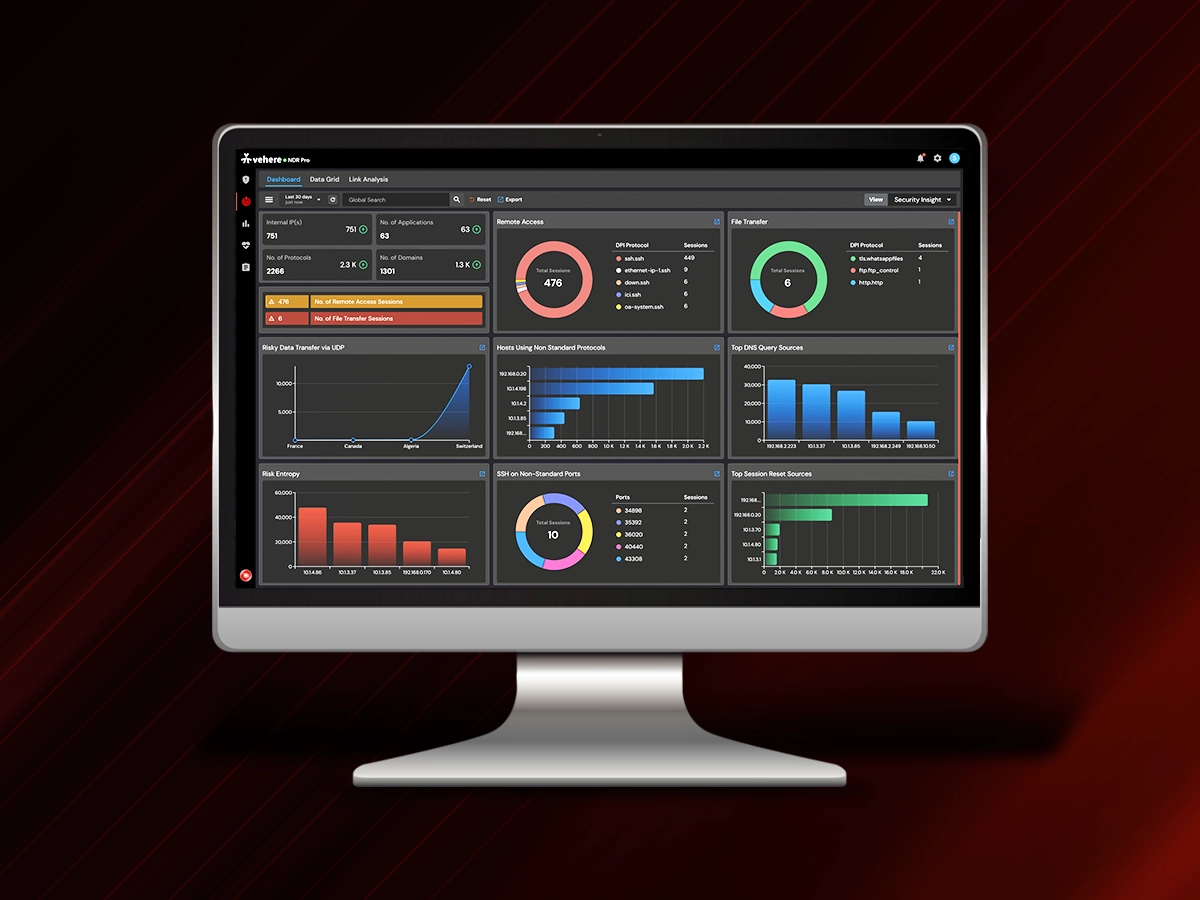


Cybersecurity is entering an era where visibility, speed and context matter more than ever.
Attackers are increasingly using legitimate credentials, encrypted communications, cloud infrastructure and sophisticated techniques to move through environments. Meanwhile, organizations are operating across hybrid networks, multiple clouds, remote users, IoT and OT environments.
For security teams, the challenge is simple; how do you detect malicious activity when no single security control can see the entire attack?
This is where Network Detection and Response (NDR) is becoming increasingly important.
Modern NDR continuously analyzes network traffic and behavior to identify anomalies, suspicious activity and threats. It complements endpoint, identity and log-based security controls by providing visibility into what is happening across the network.
So, what will shape NDR in 2026?
1. AI-Powered Threat Detection
AI and machine learning are transforming how security teams detect threats.
Traditional signatures remain important, but they can struggle with unknown or modified attacks. AI-powered NDR can establish behavioral baselines and identify deviations from normal activity.
This enables security teams to detect unusual communications, abnormal data transfers, suspicious internal activity and emerging threats faster.
The objective isn’t to replace analysts with AI. It is to help them identify the right signals faster and investigate them with greater context.
2. Encrypted Traffic Visibility Becomes Critical
Encryption protects legitimate users, but attackers can also use encrypted channels to hide command-and-control communication and data exfiltration.
Security teams therefore need ways to analyze encrypted traffic without necessarily decrypting everything.
Modern NDR can use traffic patterns, metadata, destinations, timing and behavioral characteristics to identify suspicious activity.
The question is no longer simply whether organizations can monitor encrypted traffic, but how much security intelligence they can extract from it.
3. NDR Moves Beyond the Data Center
The enterprise network has changed.
Organizations now operate across:
- On-premises infrastructure
- Public and private clouds
- Hybrid environments
- Remote offices
- SaaS applications
- Containers and dynamic workloads
Traditional monitoring can leave significant visibility gaps.
NDR is therefore evolving to provide visibility across on-premises, cloud and hybrid environments from a unified security perspective.
4. Lateral Movement Becomes a Major Detection Priority
Stopping an attacker at the perimeter is only one part of security.
Once inside, attackers can move between systems, discover critical assets, escalate privileges and access sensitive data.
Monitoring east-west traffic can reveal unusual internal communication, unexpected host-to-host connections, suspicious administrative activity and reconnaissance.
For modern SOCs, understanding what happens after an initial compromise is becoming just as important as detecting the initial intrusion.
5. Behavioral Detection Gains Importance
Attackers can modify malware, change infrastructure and use legitimate tools to avoid traditional detection.
This makes behavioral analytics increasingly important.
Modern NDR platforms can combine:
- Signature-based detection
- Behavioral analytics
- Machine learning
- Anomaly detection
- Threat intelligence
- Protocol analysis
The future isn’t signatures versus AI.
It is signatures + behavior + context + intelligence.
6. NDR, SIEM, EDR and SOAR Will Work Together
NDR is not replacing every other security technology.
Instead, each technology provides a different layer of visibility:
| Technology | Primary Visibility |
| EDR | Endpoint activity |
| NDR | Network activity and behavior |
| SIEM | Logs and security events |
| SOAR | Investigation and response automation |
For example, EDR may identify suspicious activity on an endpoint, while NDR can reveal which systems that endpoint communicated with and whether similar behavior exists elsewhere.
SIEM can correlate these signals, while SOAR can automate parts of the response.
The result is a more connected and context-rich SOC.
7. Network Forensics Becomes More Important
Detection is only the beginning of an investigation.
Security teams need to understand:
- What happened?
- When did it happen?
- Which systems were involved?
- How did the attacker move?
- What data was accessed?
Network forensics can provide the historical evidence required to reconstruct an attack.
Detection tells you something is wrong. Network forensics helps explain what happened.
This distinction will become increasingly important as attacks become more sophisticated.
8. NDR Expands Into IoT and OT Environments
Not every device can run an endpoint security agent.
Industrial systems, medical devices, IoT devices, network appliances and legacy systems can still become part of an attack.
Network-based detection provides visibility into these environments without requiring an agent on every device.
This makes NDR particularly valuable for organizations with large numbers of unmanaged or difficult-to-monitor assets.
9. Security Operations Will Become More Automated
SOC teams are dealing with increasing amounts of telemetry and alert volume.
Simply collecting more data isn’t enough.
NDR platforms are increasingly integrating with SIEM, SOAR, EDR, firewalls, NAC and threat intelligence platforms to enable:
Detect → Correlate → Prioritize → Investigate → Respond
Automation can reduce repetitive tasks and allow analysts to focus on complex investigations.
10. NDR Becomes a Security Architecture Layer
Perhaps the biggest shift is the changing role of NDR.
Modern NDR is no longer simply about monitoring network traffic. It combines:
Network visibility + behavioral analytics + threat intelligence + detection + investigation + response
As organizations adopt hybrid cloud, Zero Trust and distributed architectures, understanding how users, devices, applications and systems communicate remains critical.
NDR provides that network-level context.
What Should Security Leaders Look For?
When evaluating an NDR platform, organizations should consider:
- Broad visibility across on-premises, cloud and hybrid environments
- Multiple detection techniques, including signatures and behavioral analytics
- Encrypted traffic analysis
- Network forensics and investigation
- Integration with SIEM, SOAR, EDR and existing SOC tools
- Automated response capabilities
- Scalability for growing traffic and distributed environments
- Low alert noise and actionable intelligence
The Future of NDR
The security environment of 2026 is fundamentally different from the traditional network perimeter.
There is no single perimeter, no single source of truth and no single security product that can see everything.
The challenge is therefore shifting from collecting more data to gaining better context from the data organizations already have.
NDR has an important role in that transition.
The next generation of NDR will not simply ask:
“Is this traffic malicious?”
It will help security teams understand:
What is normal? What changed? Why does it matter? How is the attacker moving? And what should happen next?
That is ultimately the value of NDR:
Turning network visibility into security intelligence, and security intelligence into action.